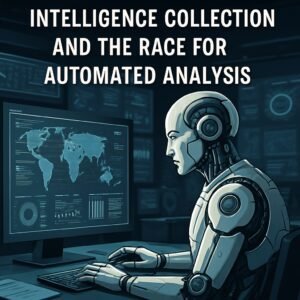
Artificial intelligence has become the most disruptive force to hit the intelligence world since the birth of the internet. Tasks that once demanded entire teams of analysts, linguists, field collectors, and technical specialists can now be completed—or at least accelerated—by systems capable of absorbing global data streams at machine speed. Intelligence organizations understand what’s happening, and a new kind of arms race has emerged: a race centered not on weapons, but on automation, prediction, and analytical velocity.
For most of the modern era, intelligence superiority was determined by reach—access to human assets, privileged signals, surveillance networks, or classified databases. That advantage is shifting. Today, superiority comes from the ability to process information faster than anyone else, turning raw data into insight before a crisis ever breaks the surface.
AI sits at the heart of this transformation. Advanced models sift through open-source data, darknet chatter, satellite feeds, financial movements, geospatial indicators, and behavioral patterns too subtle for the human eye. They identify outliers across millions of inputs, map relationships between obscure actors, and detect warning signs that would have been invisible a decade ago. What once took weeks can now unfold in minutes.
This shift isn’t merely quantitative—it’s philosophical. The traditional boundary between intelligence collection and intelligence analysis has started to dissolve. Machines now gather, structure, interpret, and even forecast, compressing multiple stages of the intelligence cycle into a single automated process. The result is a model of predictive intelligence previously considered aspirational—now increasingly standard.
None of this removes the need for human analysts. It elevates their role. The challenge is no longer finding information; it’s determining which of the machine-generated insights actually matter. Human judgment becomes the filter, the sense-maker, the strategic interpreter. Analysts become editors of an overwhelming flood rather than hunters in a barren field.
But the advantages come with equally complex risks. AI systems can be deceived through deliberate data manipulation. Adversaries can seed misleading signals into public spaces, poisoning the informational environment. Models built on flawed or incomplete data may reach conclusions that are confident—and wrong. This forces agencies to defend their own analytical engines while probing and undermining the systems their adversaries rely on.
AI-driven intelligence isn’t a future scenario—it’s the present reality. It’s reshaping cyber defense, altering counterintelligence doctrine, accelerating decision cycles, and influencing geopolitical strategy. The first “strike” in a conflict may no longer be a missile launch or a troop movement, but a rapidly generated insight delivered by an algorithm that spotted a pattern before any human noticed.
And that is the defining truth of this new era: the nation, agency, or enterprise that masters automated intelligence—especially its resilience against manipulation—will dictate the balance of power. The shift is already underway, and it’s happening faster than most institutions are prepared to admit.